Blog 2 of 3: the first engagement, in depth
This is the second post in a series about my experience as a PM on an AI data platform. Blog 1 was about how I think the PM role changed. This one goes into the first engagement, using the same six parts I'll use for the second: the problem, what I did, what we built, what I learnt building an AI platform, how I used AI to do the job, and what came of it.
1. The problem
An events company that specialises in designing and building exhibition stands. Every proposal they wrote was informed by everything they'd ever done in the past (proposals, decks, drawings, renders, estimates and photos). All that evidence was scattered across roughly twenty terabytes of files in shared drives, email and personal folders and in the memories of long serving staff. It could take anywhere from a few days to a week or two to find one comparable past job, and that was entirely dependent on who you knew.
The request wasn't "help people find things faster". The request was for the AI to write the RFI/RFP responses over three months. The sponsor was very non-technical and thought in terms of dollars and deadlines. The past responses the AI would have learnt from weren't even searchable (different formats, different naming, different locations).
Success (in the sponsor's eyes) was a faster response to every bid. Success to me was a product that the sales, creative and estimating teams would be happy to use every day. If they weren't, then nothing that came out of it would be trusted.
2. What I did
Discovery was the first surprise. I never got to sit with the people who'd actually use the product. The requirements came through the heads of each department, chosen for us, in a room where the departments were competing with each other and every slide I showed was going to be read for who it favoured. I learnt fairly quickly to be careful about what I presented, to whom, and in what order.
The moment that stayed with me: I asked three departments what "a similar project" meant and got three different answers. Sales meant a similar client or industry. The designers meant a similar look or structure. The estimators meant a similar size, venue and labour market. A product that matched filenames would have pleased nobody.
So half my discovery moved to the files themselves. What was in them, what was duplicated, which ones were images with nothing to search, what nobody had ever named consistently. The taxonomy we ended up with, the handful of ways every past job could be described so all three departments could find it, was the most important product decision on the whole engagement.
The second decision was about sequence. The client wanted AI from day one. The data couldn't support that; what it needed first was a decent, well-structured search. I persuaded the sponsor to take one year's worth of files, structure them, and make that year findable before anyone saw a model do anything clever. To make the plan land with a non-technical sponsor I framed it as a raft that became a boat, then a yacht, then a ship, with each stage carrying only what it could. The product itself we described as starting like a search engine and growing into something more like a chat assistant.
The third was how I wrote. Seven departments wanted seven different outputs, and each of them had a point. I ended up writing every decision twice, once in money terms for the sponsor and once in detail for the engineers, and I never mixed the two.
3. What we built
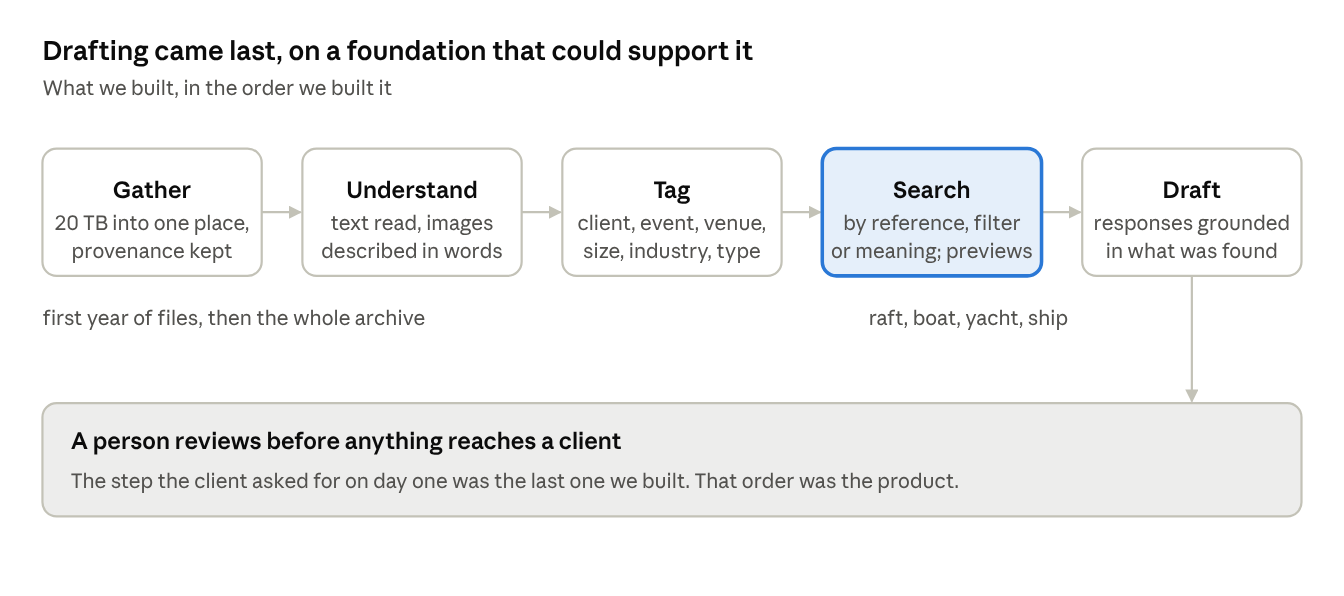
What we built, in the order we built it, with a person reviewing before anything reaches a client.
In plain terms, the platform did five things, in this order.
It gathered the archive into one place. Files were copied from the shared drives and inboxes into the cloud, with the original location, date and owner kept alongside so nothing lost its provenance.
It worked out what each file held. Text was pulled out of documents, scanned pages were read, and images and renders were described in words, so a photograph of a stand could be found by what was in it.
It tagged everything by the taxonomy. Every file got labelled with the dimensions discovery had surfaced: client, event, year, venue, stand size, industry, document type and so on. Some tags came from the files themselves; a lot were inferred by a model and left editable.
It made the archive searchable in three ways. By exact reference if you knew the job number, by filter if you knew the shape of what you wanted, and by meaning if you could describe the need but not the file. Results came back grouped by project, with a preview you could recognise and a line saying why it matched.
Then, and only then, did it draft. Once people trusted the foundation, the product could take a new RFP, pull out the requirements, find the relevant past material and draft responses grounded in it, with a person reviewing everything before anything went to a client.
That last step was the one the client had asked for on day one. It was the last thing we built, and that order was the product.
4. What I learnt building an AI platform
The data is the product decision. I didn't know that curating the corpus was the PM's job. It turned out to be most of it. A model can only find what someone has made findable.
Search before generation. An answer generated over an archive nobody trusts is confident nonsense. A search result with a preview, grouped by project, that people did trust did more for adoption than any clever draft would have.
Show each stage with what it can carry. The raft-to-ship thing worked because every stage had a picture people could hold in their head and an honest limit attached.
The first real result is the moment that matters. The day the first proper result came back on real files, grouped by project with a thumbnail you could actually recognise, the mood of the whole engagement changed. Relief, mostly. Then a sort of greed to see what else it could do.
5. How I used AI to do the job
This is the other thread, and I want to keep it clearly separate. This isn't what the product did. It's how I worked.
As a tutor. I'd learn a concept at midnight, retrieval, embeddings, chunking, in the plainest terms I could get, and explain it to a finance audience the next morning without a single technical word.
As a drafting partner. AI took pages of interview notes and turned them into a first-draft taxonomy I could hand to the departments to correct. It drafted the second version of every decision, so writing for two audiences didn't double my week. And it helped me test the analogies until they'd survive a sceptical room.
As a prototyping tool. A few weeks in I discovered I could describe a screen to an AI prototyping tool and have something clickable back within the hour. It was my first prototype, and far from my last. A sponsor who thought in dollars could suddenly see what the dollars bought, and people who struggled to say what they wanted could tell me straight away what to change. I also learnt more about UX from this than from years of sitting next to designers, because for the first time I was making the choices myself and watching what landed.
Somewhere in those months I stopped thinking of AI as the thing we were building and started thinking of it as the way I worked.
6. The outcome
The search went live on that first year of files, then grew to cover the archive, and the drafting followed once people trusted what sat underneath it. Finding a comparable past job, which had taken anywhere from a few days to a week or two, now takes less than a minute and no longer depends on who remembers it. The platform went from discovery into production, with the drafting the client had first asked for arriving last, on a foundation that could carry it. The outcome I value most is quieter than that: a non-technical client came to see AI as something staged, explainable and checkable, which in my experience is the only way it gets adopted at all.
Blog 3 takes the same six parts to the second engagement, where the data doesn't stand still and the product has to prove its own answers.
Drafted with AI assistance, as is my standing practice. The experience, the mistakes and the opinions are mine.
Comments
Join the conversation. You can edit your comments later using this browser. Clearing site data removes that edit access.