Blog 1 of 3: what a decade of product work did and did not prepare me for
In the past two years, I've led two AI engagements in the data space that solve opposite problems. One turned a static archive of twenty terabytes into answers. The other turns live public data into decisions leaders act on. Both pushed my product management skills further than any work before them, and both changed how I do the job itself. This is the first of three posts. It covers where I started and how I think the PM role changes on an AI data platform. The next two go deep on each engagement.
Where I started
I came to product management the long way round. I started out as an analyst, then spent years as a business analyst and product owner, and along the way I was always asking what problem we were solving and for whom, well before anyone asked when it would ship. Eventually the title caught up with the habit. Over a decade and more, that took me through workplace advisory, retail and loyalty, government services, payments and education, in product companies and in consultancies.
My AI experience, when the first engagement arrived, was one machine learning project: software that read handwritten letters so an operations team didn't have to. I was new to shipping language-model-based products. I knew retrieval and embeddings the way you know a country from its guidebook, and I was just beginning to explore agents. I learnt all three from the ground up over the two engagements, partly from the engineers and domain experts I worked with and partly with AI as my midnight tutor, explaining a concept in plain terms so that I could explain it to a sponsor the next morning without a single technical term. I want to be specific about that, because the rest of this series only makes sense if you know I learnt it properly rather than picking up the vocabulary.
Two engagements, opposite problems
The first engagement: finding what was already true. An events company whose proposals drew on everything it had ever built. Roughly twenty terabytes of proposals, decks, drawings and images across shared drives and inboxes, and a client who wanted AI to write their RFI and RFP responses within three months. The past responses the AI would have learnt from weren't even searchable. We turned that archive into an answer engine: findable first, understood next, and only then drafting responses grounded in what was actually there.
The second engagement: proving what is true now. A product that reads public data sources as they change, works out where an organisation stands against its peers, and tells its leaders where to invest. Leaders were making real decisions under real pressure, so every figure had to be traceable to its source and checked before it was published. Agents did the reading; the product's job was to prove its own answers.
Same domain, opposite problems. One looks backward into a corpus that doesn't change; the other looks outward at sources that can change at any moment.
Two threads, kept separate
Running through both engagements are two different threads, and I've learnt to keep them apart. Blurring them is how PMs talk themselves into thinking they understand AI when they've only used it.
The first thread is building AI platforms: the product decisions that only exist when a model sits inside the product. What data it reads, how that data is structured, how the user knows an answer is right, what the model is allowed to reach.
The second thread is using AI to do the PM job: how I now learn, draft, prototype and check builds with AI beside me. That thread has changed my working day more than any tool I've used.
Each of the next two posts carries both threads in their own labelled sections. This post is about what they add up to.
How the PM role changes on an AI data platform
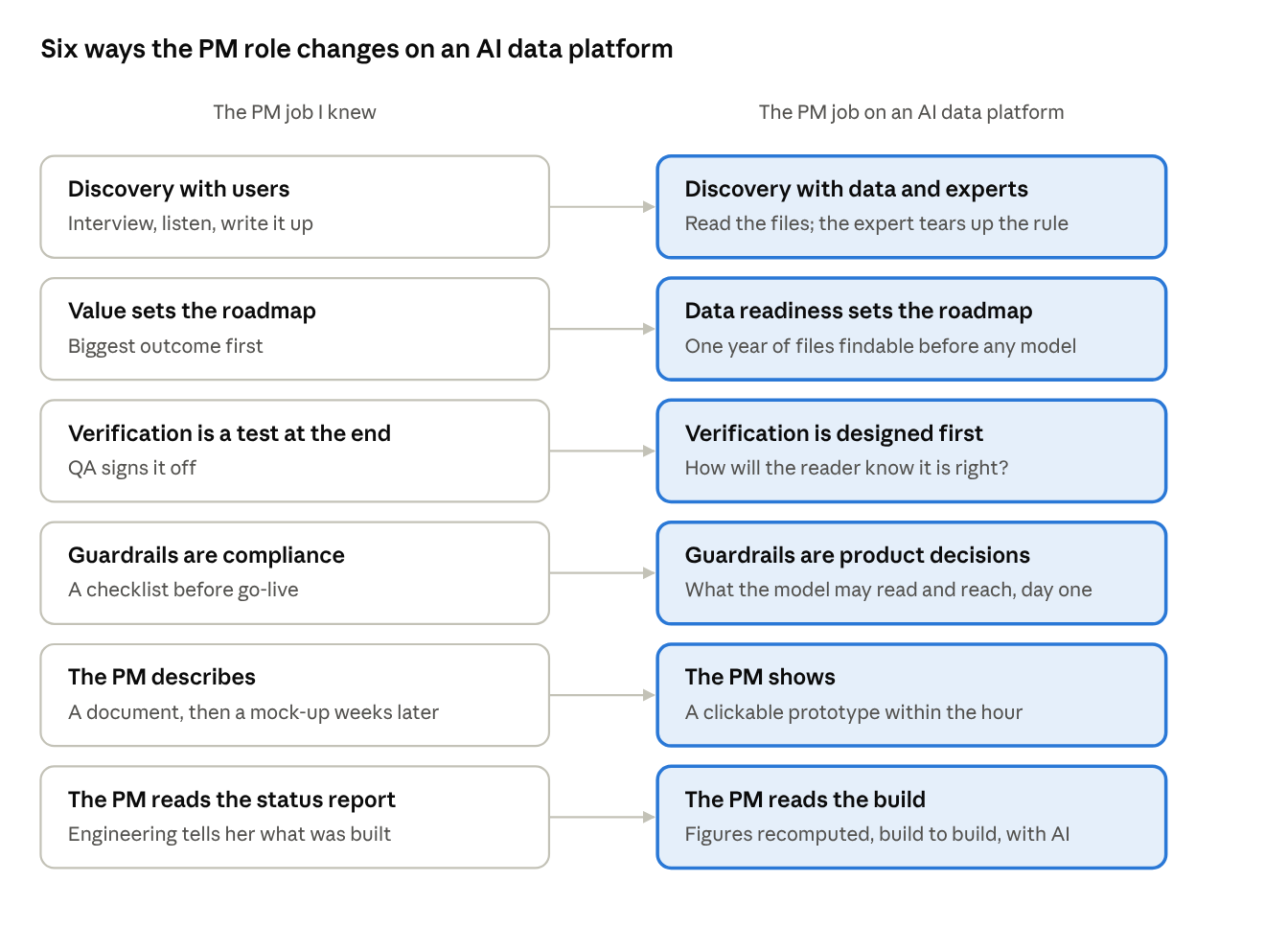
Six moves, each with a one-line example here and the full story in the next two posts.
1. Discovery moves from users to data and to experts: On the first engagement, half my discovery was on the files themselves; on the second, it was a loop with a domain expert who tore up each rule I proposed until it was right.
2. Data readiness, not value alone, sets the roadmap: The client wanted AI on day one; the hardest call I made in two years was to make one year of files findable before any model did anything clever.
3. Verification is a product requirement designed first, not a test at the end: A report nearly went out with a total that read perfectly well and had nothing underneath it, and the question I now ask first is "how will the reader know this is right?"
4. Guardrails are product decisions made on day one: What the model may read, what it may reach, and what happens when it's wrong; every guardrail we named raised the client's confidence.
5. The PM makes things visible herself: I described a screen to an AI prototyping tool and had something clickable within the hour, and a sponsor who thought in dollars could suddenly see what the dollars were buying.
6. The PM works much closer to engineering, because AI lets her read and check the build: I'm not an engineer, but every morning I recomputed the figures in the latest build with AI beside me, and the first time I was right about a mismatch, the conversation with engineering changed for good.
What comes next
Blog 2 goes deep on the first engagement: how twenty terabytes of archive became an answer engine, what we built, what I learnt building it, how I used AI to do the job, and what it changed for the client. Blog 3 does the same for the second: a product that proves its own answers.
If you're a product manager making the same move from conventional delivery into AI, I'd love to know what stretched you first. And if you've already been down this road, what do you wish someone had told you at the start?
Drafted with AI assistance, as is my standing practice. The experience, the mistakes and the opinions are mine.
Comments
Join the conversation. You can edit your comments later using this browser. Clearing site data removes that edit access.